eSorptionProbe

Hand-held QCM-D with connectivity option for EQCM-D

eSorptionProbe

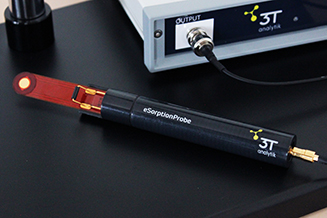
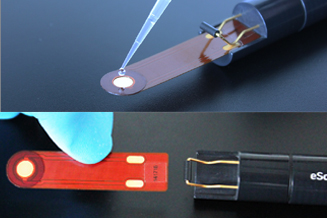
QCM-D, Simplified—The eSorptionProbe enables fast and effortless QCM-D measurements in static mode. Its slim sensor-probe holder allows direct immersion into sample solution or simple pipetting of small droplets onto the sensor surface. No flow cells, pumps, or complex handling are required. QCM-D has never been easier.

Features of eSorptionProbe:

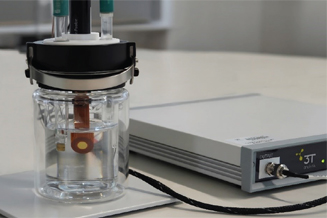
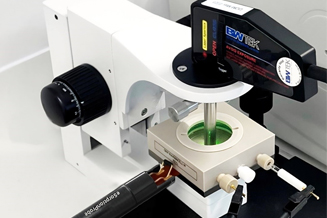
• Slim & Versatile: Integrates seamlessly into standard electrochemistry glassware and is compatible with complementary surface analysis techniques such as Raman spectroscopy, contact angle measurements, and microscopy.
• Immersion-Ready: Mounted on a thin polymer sheet, allowing direct immersion into beakers for in-situ experiments.
• Small Sample Volume: Enables QCM-D measurements with volumes as low as 50 μL via pipetting.
• Bubble-Free Design: Cavity-free probe geometry and vertical insertion allow gas bubbles to escape freely, minimizing measurement interference.
• Plug & Play Operation: Pre-mounted, ready-to-use consumable sensor probe eliminates fiddly handling—insert under the clip and start measuring within seconds.
• Application-Adaptable: Available with a wide range of sensor coatings, including Au, Cu, Pt, Ag, and Pd, to suit diverse experimental needs.
• High Sensitivity & Viscoelastic Insight: 10 MHz sensors provide ~4× higher mass sensitivity than 5 MHz sensors. Simultaneous frequency and damping readout at 10, 30, and 50 MHz harmonics enables viscoelastic modeling of soft films and interfaces.
• Expert Support Included: Developed through a collaboration between Metrohm Autolab and 3T analytik, ensuring expert guidance in both QCM-D and electrochemistry.
• Integrated Software Workflow: Fully controlled via NOVA and qGraph, with synchronized QCM-D and electrochemistry data visualized in qGraphViewer and easily exported to Excel, Origin, or SigmaPlot for further analysis.


 

Effortless Handling and Efficient Operation

Measurements start within seconds by dipping the sensor probe directly into the sample or by pipetting a small droplet onto the sensor surface. After use, the cost-effective sensor probe can be exchanged within seconds for cleaning or replacement, minimizing downtime and maximizing experimental throughput.

High-Sensitivity Multi-Harmonic Readout

The eSorptionProbe operates with a tongue-shaped QCM-D sensor probe integrated with a 10 MHz quartz sensor. Frequency and damping (dissipation) are measured simultaneously at 10, 30, and 50 MHz (1st, 3rd, and 5th harmonics). Operation at 10 MHz provides approximately 4× higher mass sensitivity than conventional 5 MHz sensors, while multiharmonic readout enables viscoelastic modeling and highly reproducible characterization of thin films and soft interfaces.

A New Way to Perform QCM-D and EQCM-D — Without Compromise

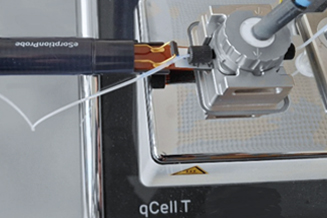
The eSorptionProbe prevents trapped air bubbles with a cavity-free probe design, ensuring stable and reproducible measurements. Its compact probe geometry enables seamless integration into flow-cell setups and hybrid experimental systems. The slim probe holder features a secure contact clip with integrated SMB cable connectors for QCM-D signal readout, while the in-line plug enables optional working-electrode (WE) connection for electrochemical measurements.
By simplifying experimental setup while maintaining high measurement performance, the eSorptionProbe introduces a practical, research-ready approach to QCM-D and EQCM-D, suitable for both academic studies and applied applications.

Controlled Layer-by-Layer and Dip-Coating Analysis

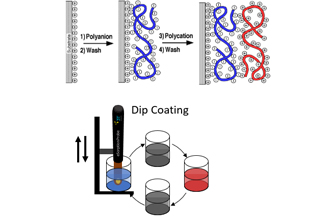
The eSorptionProbe enables direct, real-time monitoring of layer-by-layer and dip-coated films. These processes are often challenging in conventional QCM-D systems due to flow-cell clogging and tubing contamination. Unlike deposition via flow cells, the cavity-free, direct-immersion design allows films to be formed and measured under conditions that closely reflect true dip-coating workflows. This capability supports fundamental research on layer growth, thickness, and mechanical properties, while also enabling control and optimization of dip-coating processes for functional and protective coatings, optical films, biomedical surfaces, membranes, and nanostructured layers. It effectively bridges laboratory analysis with production-relevant development.

Designed for Electrochemistry

The eSorptionProbe integrates EQCM-D seamlessly into standard electrochemical workflows—not the other way around. When combined with a potentiostat, it functions as both a mass sensor and working electrode in EQCM-D experiments. Acting as a drop-in replacement for the working electrode, it works with standard reference and counter electrodes in conventional beaker setups.Vertical insertion allows gas bubbles to escape freely, minimizing interference.

Expanding the Scope of Surface Analysis

The tongue-shaped sensor probe features a purpose-designed geometry for easy integration with additional devices and compatibility with complementary surface analysis techniques—such as Raman spectroscopy, contact angle measurements, and microscopy—allowing in-depth surface characterization. Its demonstrated ability to combine electrochemistry, QCM-D, and Raman spectroscopy in real time on a single surface highlights the versatility and multi-mode potential of the eSorptionProbe.